Updated: September 26, 2026
The Delhi Mumbai Expressway is one of India’s major greenfield highway projects. It is being developed to create a faster, access-controlled road connection between the Delhi-NCR region and Mumbai, while also improving links with industrial centres, logistics hubs, ports and other important economic locations.
The project is being implemented by the National Highways Authority of India (NHAI) under the Ministry of Road Transport and Highways as part of the Bharatmala highway development programme.
The expressway is being developed in multiple packages and sections. Several stretches are already operational, while some sections are still under construction or balance work.
For Maharashtra, the project is particularly important because the corridor connects with the Palghar region, Mumbai Metropolitan Region and Jawaharlal Nehru Port Authority (JNPA) network. It also connects with other major infrastructure projects being developed around Palghar, Vadhavan, Navi Mumbai and the wider Mumbai region.
What Is the Delhi Mumbai Expressway?
The Delhi Mumbai Expressway is a greenfield, access-controlled expressway designed to provide high-speed connectivity between Delhi and Mumbai.
Unlike an ordinary highway that passes through numerous towns and urban areas, an access-controlled expressway has limited entry and exit points. This can help long-distance traffic move more efficiently.
Government documents use different lengths for the project because some figures refer to the main expressway while others include spur roads and associated connectivity.
The Ministry of Road Transport and Highways, reported a implementation scope of 1,445 km across 54 construction packages when spur connectivity is included.
The broader corridor connects the Delhi-NCR region with Haryana, Rajasthan, Madhya Pradesh, Gujarat and Maharashtra.
Latest Update on the Delhi Mumbai Expressway
The latest official information shows that the Delhi Mumbai Expressway is partially operational and not yet fully complete across all sections.
In a March 25, 2026, the Ministry of Road Transport and Highways reported that the broader corridor, including spur connectivity, covered 54 construction packages with a total length of 1,445 km. Of this, 929 km had been operationalised.
The same official update stated that the Delhi-Vadodara section was about 912 km long, of which 697 km had been operationalised and 215 km remained under implementation.
The Ministry also reported that some Gujarat packages had experienced delays and that three such packages in the Vadodara-Mumbai section were targeted for completion by March 2028. Other packages were targeted for completion during 2026.
The official project status should therefore be understood as section-wise and package-wise, rather than by using one single completion date for the entire corridor.
Maharashtra Section: Latest Position
The Maharashtra section has a separate significance because it connects the expressway network with the Mumbai region and the JNPT side.
During a review in June 2026, the Maharashtra government reported that the Maharashtra portion of the Vadodara-Mumbai section was around 157 km and involved an estimated investment of about ₹24,000 crore.
Five of the seven packages were reported as completed, with work on the remaining packages progressing toward completion. An August 31, 2026 target was reported for making the entire Maharashtra stretch traffic-ready.
Delhi Mumbai Expressway: Key Project Details
| Parameter | Details |
|---|---|
| Project Name | Delhi Mumbai Expressway |
| Project Type | Greenfield, access-controlled expressway |
| Implementing Agency | National Highways Authority of India (NHAI) |
| Programme | Bharatmala Pariyojana |
| Planned Corridor Length | Approximately 1,386 km |
| Broader Package Scope | 1,445 km including spur connectivity |
| Design | Eight lanes, with provisions for future expansion in the corridor |
| Main States/Regions | Delhi, Haryana, Rajasthan, Madhya Pradesh, Gujarat and Maharashtra |
| Maharashtra Connectivity | Virar/Mumbai region and JNPT through associated connectivity |
| Sanctioned Cost Reported by MoRTH | ₹96,547 crore |
| Rounded Cost Mentioned in 2026 Government Communication | Around ₹1 lakh crore |
| Operational Status | Partially operational |
| Operationalised Length Reported in March 2026 | 929 km under the broader package scope |
| Overall Completion | Staggered, with some sections still under implementation |
| Latest Reported Delayed Gujarat Package Target | March 2028 |
Delhi Mumbai Expressway Route
The Delhi Mumbai Expressway follows a new alignment connecting the Delhi-NCR region with western India.
The broader corridor passes through:
Delhi-NCR → Haryana → Rajasthan → Madhya Pradesh → Gujarat → Maharashtra → Mumbai/JNPT region
Important economic and urban centres connected through the corridor and associated routes include Dausa, Kota, Ratlam, Vadodara and Surat, followed by the Mumbai-region network.
The Maharashtra portion is particularly important because the corridor connects with the Virar-Palghar side and the JNPT/Navi Mumbai port network.
The project is therefore not only a passenger transport corridor. It is also designed to support freight movement, logistics and industrial connectivity.
Maharashtra Connectivity and Important Areas
For Maharashtra, the project is relevant to areas including Palghar, Vasai-Virar, Bhiwandi, Navi Mumbai and the JNPT region.
The impact on individual locations will depend on actual interchange points and connecting roads.
A useful example is the proposed and upgraded NH-160A corridor connecting Ghoti, Trimbak, Jawhar, Manor and Palghar. The government has described this road as an important link to the Delhi Mumbai Expressway, Mumbai-Nagpur Samruddhi Mahamarg, NH-48 and other regional infrastructure.
This is important because the value of a major expressway depends not only on the main road itself but also on the quality of the roads connecting towns and economic centres to the expressway.
Readers interested in the wider transformation of the Palghar region can also read MakaanExpert’s Palghar Airport project guide.
JNPT and Port Connectivity
One of the most important features of the Delhi Mumbai Expressway is its relationship with Jawaharlal Nehru Port Authority (JNPA).
The corridor and its associated spurs are intended to improve the movement of goods between northern and western India and the Mumbai-region port network.
This is especially important for Maharashtra because JNPA is a major cargo gateway and because additional port-related infrastructure is being developed in the region.
The proposed Vadhavan Port in Palghar district is another major project that could influence the future logistics network of northern Maharashtra.
Road and rail connectivity to such large infrastructure projects can support the movement of goods and may also encourage related warehousing, industrial and commercial activity.
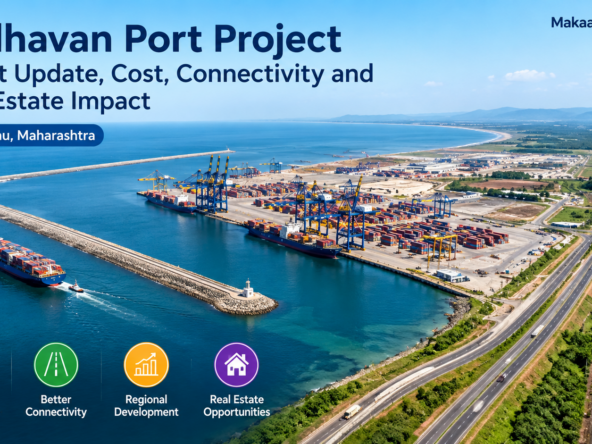
In April 2026, NHAI awarded work for a 32.1-km, four-lane, access-controlled road connecting Vadhavan Port to Tava village on NH-48. This road is planned to connect with the Delhi Mumbai Expressway and the existing national highway network.
This creates the possibility of a larger integrated road-port-logistics network in the region rather than the expressway operating as an isolated project.
Delhi Mumbai Expressway and Bhiwandi-Navi Mumbai Connectivity
The Mumbai-side network also makes areas such as Bhiwandi and Navi Mumbai relevant to the project.
However, the Delhi Mumbai Expressway should not be interpreted as providing direct expressway access to every locality in the Mumbai Metropolitan Region.
The actual benefit to a location will depend on:
- Distance from the nearest interchange
- Quality of approach roads
- Travel time to the expressway
- Traffic conditions on connecting roads
- Access to industrial and commercial hubs
- Availability of supporting infrastructure
Bhiwandi is already a major warehousing and distribution market, and improved access to major highways can support logistics activity in the wider region.
For property buyers, this means that a project advertisement describing a development as “near the Delhi Mumbai Expressway” should always be checked against the actual road route and interchange location.
Benefits of the Delhi Mumbai Expressway
Faster Long-Distance Travel
One of the main objectives of the project is to reduce travel time between Delhi and Mumbai.
Government information has indicated that, once the corridor is fully developed, travel time could be reduced substantially compared with the older road network.
Actual journey time will still depend on the starting point, exit point, traffic, tolling, vehicle type and local road conditions.
Better Freight Movement
Freight connectivity may be one of the most important long-term benefits.
An access-controlled corridor can help long-distance freight traffic avoid many congested urban stretches and improve the efficiency of road transport.
This can be particularly useful for companies moving goods between manufacturing centres, distribution hubs and ports.
Stronger Industrial Connectivity
The expressway links several industrial and economic regions across western and northern India.
Government have also highlighted connections with economic nodes, logistics facilities, ports and airports.
Improved connectivity may support further business activity in locations where land, utilities, labour and industrial infrastructure are already available.
Logistics and Warehousing Growth
Improved highway access can make selected locations more attractive for:
- Warehouses
- Distribution centres
- Industrial units
- Transport facilities
- Cold-chain operations
- Logistics parks
However, highway access alone does not automatically create a successful logistics market. Land availability, zoning, labour, electricity and local transport connectivity remain important.
Development of Supporting Infrastructure
The expressway is also encouraging development and upgrading of feeder infrastructure.
For example, road projects connecting Palghar and other economic nodes can make it easier for local areas to connect with national highways and expressways.
Readers can also explore MakaanExpert’s coverage of PM Gati Shakti and India’s integrated infrastructure planning.
Delhi Mumbai Expressway Impact on Real Estate
The Delhi Mumbai Expressway may influence property markets, but its effect will vary significantly by location.
The most important point for buyers and investors is that better road connectivity does not automatically guarantee property-price appreciation.
The real estate impact is more likely to become visible where connectivity is supported by jobs, commercial activity, industrial development and civic infrastructure.
Residential Development
Areas that gain easier access to employment and transport hubs may become more attractive for residential development.
This could be relevant to selected locations around Palghar, northern MMR and other developing urban centres.
Commercial Development
Commercial and industrial property may benefit where the expressway improves access to major markets and transport hubs.
Businesses that depend on road logistics can place greater value on locations that provide efficient access to highways and freight corridors.
Rental Demand
Rental demand could increase in locations where infrastructure improvements are accompanied by:
- New employment opportunities
- Industrial development
- Warehousing activity
- Commercial projects
- New transport facilities
An expressway by itself does not guarantee higher rental demand.
Land Development
Large infrastructure projects can make previously less accessible areas easier to reach.
This may encourage development in selected locations, especially where planning permissions and supporting infrastructure are available.
Land buyers should nevertheless verify:
- Land title
- Zoning
- Development-plan reservations
- Road access
- Acquisition status
- Environmental restrictions
- Flood risk
- Availability of utilities
- Actual distance from the expressway interchange
Buyer Interest
Improved accessibility may increase buyer interest in selected locations.
This is particularly possible where several projects come together, such as highways, ports, industrial areas, railways and airports.
At the same time, buyers should not assume that every property near the expressway will experience the same market response.
Why Palghar Could Be Important for Real Estate
Palghar district is one of the areas worth monitoring because several major infrastructure projects are being planned or developed in the wider region.
These include:
- Delhi Mumbai Expressway
- Vadhavan Port
- NH-160A connectivity improvements
- Proposed aviation infrastructure
- Port-related road and rail projects
- Existing railway connectivity
- Industrial areas around Tarapur and Boisar
The February 2026 government announcement on NH-160A specifically referred to links with economic nodes and infrastructure around Palghar, Tarapur, Boisar, Vadhavan and JNPA.
This creates the potential for a broader infrastructure-led economic network.
MakaanExpert’s Thane-Borivali Tunnel Project article provides another example of how major road infrastructure can affect travel patterns and the wider property market.
Similarly, MakaanExpert’s Thane Metro Phase 1 article explains how public transport infrastructure can influence urban connectivity.
The broader lesson is that property markets tend to respond to overall connectivity and economic development, rather than to a single project in isolation.
Current Status, Timeline and Challenges
The Delhi Mumbai Expressway has gone through several changes in its planned completion timeline.
Earlier project schedules had targeted earlier completion, but different construction packages have progressed at different speeds.
A July 2024 government update had reported substantial physical progress and a revised completion target of October 2025. However, the project was not fully operational across the entire corridor by that date.
The March 2026 official position provided a more detailed package-wise picture.
According to the Ministry of Road Transport and Highways:
- 929 km had been operationalised within the broader implementation scope.
- Several sections were targeted for completion during 2026.
- Three delayed Gujarat packages were targeted for completion by March 2028.
The Maharashtra section had a reported target of August 31, 2026, but that should not automatically be interpreted as the confirmed final operational date for every Maharashtra package.
What It Means for Homebuyers and Property Buyers
For someone considering a property near the Delhi Mumbai Expressway, the project can be a useful factor, but it should not be the only factor.
Check the Actual Interchange
A property may be described as “close to the expressway” even when the nearest official entry point is much farther away.
Always check the actual route and travel time to the interchange.
These are very different stages.
Check Local Infrastructure
A good expressway connection does not eliminate local infrastructure problems.
Also examine:
- Internal roads
- Water supply
- Drainage
- Electricity
- Public transport
- Schools
- Hospitals
- Employment centres
Check Land and Planning Documents
For land purchases, buyers should verify zoning, title, reservations, acquisition notices and development permissions before making a decision.
Delhi Mumbai Expressway and Pune
Pune is an important real estate market in Maharashtra, but the Delhi Mumbai Expressway is not a direct Pune corridor.
Its main Maharashtra relevance is around the Mumbai Metropolitan Region, Palghar and the JNPT-side network.
Pune and PCMC may benefit indirectly from wider improvements in Maharashtra’s road and logistics network, but areas such as Hinjewadi, Wakad, Baner, Kharadi, Hadapsar, Wagholi, Ravet, Tathawade, Moshi, Chakan and Talegaon should not be described as direct Delhi Mumbai Expressway locations without a specific connecting infrastructure link.
This distinction is important for both readers and property buyers.
Delhi Mumbai Expressway: What Happens Next?
The next stage of the project will depend on completion of the remaining construction packages and improved integration with surrounding highways and regional infrastructure.
In Maharashtra, the combination of the Delhi Mumbai Expressway, Vadhavan Port, NH-160A improvements and other regional transport projects could gradually reshape the logistics and development pattern of parts of the state.
For property markets, the effect is likely to be strongest in locations where better connectivity is accompanied by employment, business activity, industrial investment and improved civic infrastructure.
That means buyers should look at the entire infrastructure ecosystem rather than focusing only on the expressway itself.
Conclusion
The Delhi Mumbai Expressway is a major national infrastructure project that is already operational across substantial sections, while construction continues on selected packages.
The latest official information shows that 929 km had been operationalised by March 25, 2026 under the broader project scope that includes spur connectivity. Other sections were targeted for completion during 2026, while three delayed Gujarat packages were targeted for March 2028.
For Maharashtra, the project is especially relevant because of its connection with Palghar, the Mumbai Metropolitan Region, JNPA and emerging logistics and port infrastructure.
From a real estate perspective, the project may improve accessibility, support business activity and increase interest in selected locations. However, there is no uniform impact on every property market along the route.
For homebuyers and investors, the most important factors remain actual interchange access, local roads, employment opportunities, civic infrastructure, land-use rules and the verified status of surrounding projects.
The Delhi Mumbai Expressway should therefore be viewed as part of a much larger road, logistics, port and regional development network that could influence the future growth of parts of Maharashtra and other states along the corridor.
FAQs
What is the Delhi Mumbai Expressway?
The Delhi Mumbai Expressway is a greenfield, access-controlled highway being developed by NHAI to improve high-speed road connectivity between Delhi-NCR and Mumbai through Haryana, Rajasthan, Madhya Pradesh, Gujarat and Maharashtra.
Where is the Delhi Mumbai Expressway located?
The broader corridor connects Delhi-NCR with Mumbai through Haryana, Rajasthan, Madhya Pradesh and Gujarat before reaching Maharashtra and the Mumbai-region network.
What is the current status of the Delhi Mumbai Expressway?
The project is partially operational. According to the Ministry of Road Transport and Highways, 929 km had been operationalised by March 25, 2026, within the broader project scope including spur connectivity.
When will the Delhi Mumbai Expressway be completed?
There is no single completion date for all packages. Some sections were targeted for completion during 2026, while three delayed Gujarat packages were targeted for March 2028.
What is the cost of the Delhi Mumbai Expressway?
The sanctioned cost reported by the Ministry of Road Transport and Highways in March 2026 was ₹96,547 crore. A June 2026 government communication referred to the broader project cost as approximately ₹1 lakh crore.
Which Maharashtra areas could benefit from the Delhi Mumbai Expressway?
Areas that may benefit directly or indirectly include parts of Palghar, Vasai-Virar, Bhiwandi, Navi Mumbai and the JNPT region, depending on interchange and feeder-road connectivity.
How could the Delhi Mumbai Expressway affect real estate?
Better connectivity could support residential, commercial, logistics and industrial activity in selected locations. However, the project does not guarantee higher property prices. Employment, civic infrastructure, local roads and actual accessibility will also influence demand.
Is the Delhi Mumbai Expressway directly connected to Pune?
Pune is not located on the main Delhi Mumbai Expressway alignment. Pune may benefit indirectly through the wider Maharashtra road and logistics network, but Pune and PCMC should not be described as direct expressway locations.