Introduction
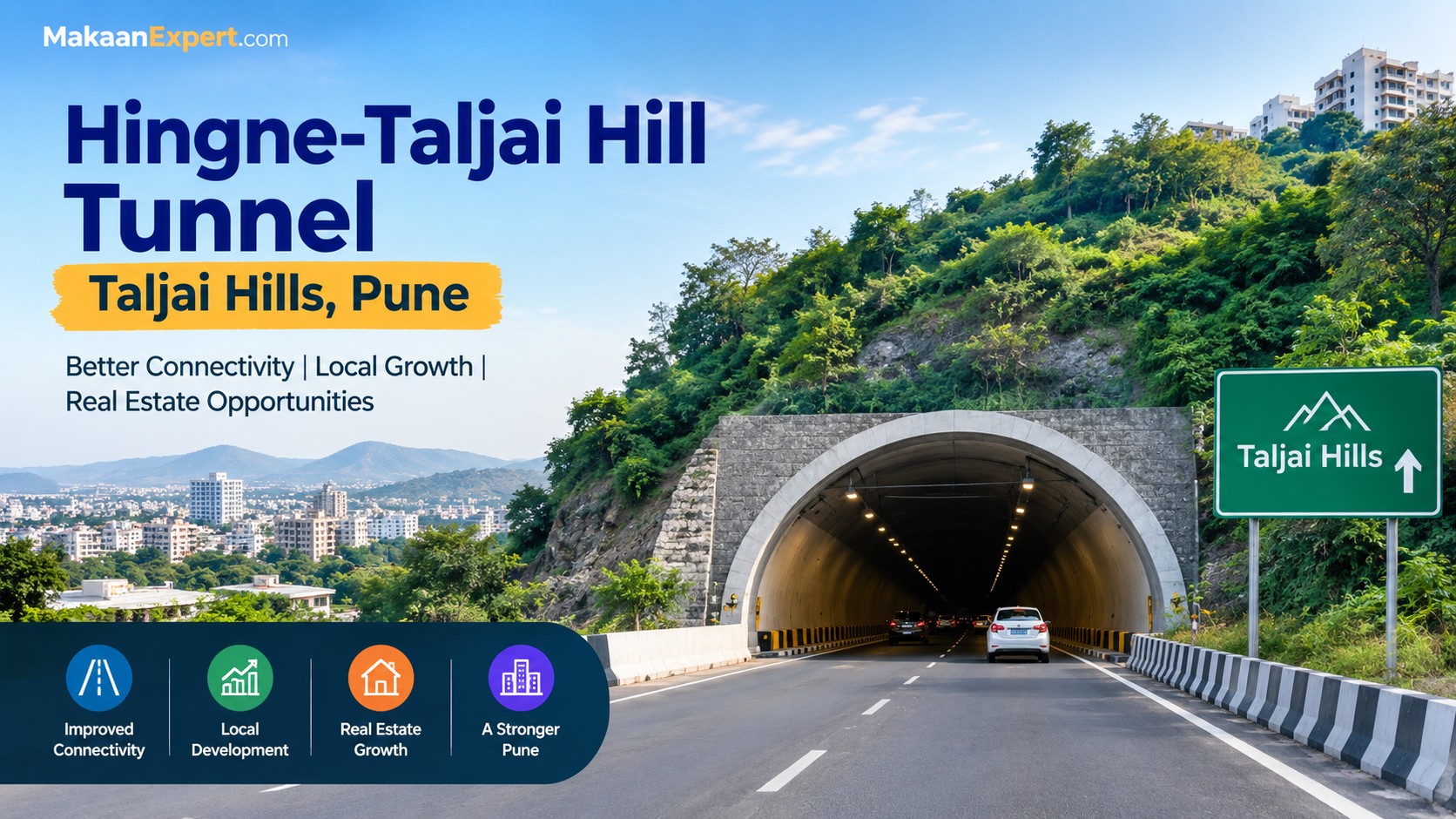
The proposed Taljai Hill Tunnel Pune project is once again in focus as the Pune Municipal Corporation (PMC) examines a direct road connection between Hingne Khurd on Sinhagad Road and Sahakarnagar on Satara Road.
The proposal is intended to create an alternative route below Taljai Hill and reduce the need for traffic between the two sides of the city to pass through more congested routes. The project could also improve connectivity for areas such as Taljai, Padmavati, Bibwewadi, Dhankawadi, Katraj and Karvenagar.
The latest development came in September 2026, when Pune Mayor Manjusha Nagpure inspected the proposed alignment around Hingne-Khorad Vasti and sought information about the project’s feasibility, technical requirements and implementation needs.
However, the project should not be treated as an under-construction tunnel. As of September 2026, it is still being examined, with detailed project, structural, environmental and financial issues yet to be finalised.
For the official PMC inspection update, see the Pune Municipal Corporation project update.
What Is the Taljai Hill Tunnel?
The Taljai Hill Tunnel is a proposed underground road connection through the Taljai Hill area of Pune.
Its main purpose is to provide a more direct connection between:
Hingne Khurd / Sinhagad Road → Taljai Hill → Sahakarnagar / Satara Road
The idea is not new. The tunnel proposal has been discussed for many years. A proposal was reported in the PMC’s 2011 planning process, while the project received a ₹2 crore provision in the 2018-19 municipal budget for preparation of a detailed project report. At that time, the actual alignment had still not been finalised.
A 2018 report also noted that the DPR was expected to examine the alignment, approach roads, environmental impact and overall feasibility of the project.
The proposal returned to the spotlight in January 2025 when PMC said it would carry out a cost-benefit study to examine traffic demand and project feasibility.
In August 2026, the proposed Taljai-area tunnel was again reviewed at the state level. Officials were asked to progress the DPR, structural design and environmental impact studies while addressing biodiversity, groundwater and safety issues.
Latest Update on Taljai Hill Tunnel Pune
The latest publicly reported development came in September 2026.
On 18 September 2026, Pune Mayor Manjusha Nagpure inspected the proposed tunnel alignment in the Hingne-Khorad Vasti area. Civic officials explained the feasibility and technical requirements of the project. The inspection also covered road widening and a proposed culvert in the same area.
On 21 September 2026, reporting on the project said PMC was pushing the long-pending proposal to connect Hingne Khurd with Sahakarnagar. The civic administration was also examining whether the project could reduce both travel distance and travel time.
At the same time, there is still no publicly confirmed construction schedule. The latest reports indicate that feasibility, technical design, environmental assessment, funding and project economics remain important steps before construction can begin.
This distinction is important for property buyers: the Taljai Hill Tunnel is a proposed infrastructure project, not a completed or fully approved operational project.
Key Project Details
| Parameter | Details |
|---|---|
| Project Name | Taljai Hill Tunnel / Taljai-Hingne Tunnel |
| Location | Pune, Maharashtra |
| Project Type | Road Tunnel |
| Primary Route Under Examination | Hingne Khurd on Sinhagad Road to Sahakarnagar on Satara Road |
| Wider Areas Expected to Benefit | Taljai, Padmavati, Bibwewadi, Dhankawadi, Katraj and Karvenagar |
| Implementing Agency | Pune Municipal Corporation (PMC) |
| Length / Capacity | Final length and traffic capacity have not been publicly confirmed |
| Reported Width | A 24-metre-wide concept was reported in 2025; final technical specifications remain subject to project studies |
| Estimated Cost | Final construction cost has not been publicly finalised |
| Earlier Budget Provision | ₹2 crore in 2018-19 for the DPR/consultancy process, not the final construction cost |
| Current Status | Proposal / feasibility / DPR, structural and environmental study stage |
| Construction Status | Construction has not been confirmed as started |
| Expected Completion | No official completion date confirmed |
| Funding / Revenue Model | Not finalised; PMC officials have discussed the possibility of toll-based cost recovery for expensive tunnel projects |
Taljai Hill Tunnel Route and Connectivity
The proposed route is primarily intended to link two important road corridors in Pune:
Sinhagad Road on the Hingne Khurd side and Satara Road on the Sahakarnagar side.
At present, road traffic between these parts of Pune has to rely on existing city routes. The proposed tunnel could create a more direct alternative by passing below the hill rather than requiring vehicles to travel around it.
Areas on the Sinhagad Road side
Hingne Khurd is an important residential area connected to the wider Sinhagad Road corridor. Sinhagad Road also serves neighbourhoods extending towards Vadgaon, Dhayari and Nanded.
MakaanExpert’s Nanded City and Sinhgad Road locality guide provides additional background on residential development and connectivity along this corridor.
Areas on the Satara Road side
The proposed connection could improve access towards Sahakarnagar, Padmavati, Bibwewadi, Dhankawadi and Katraj.
These are established residential and commercial areas with strong links to the southern parts of Pune. MakaanExpert’s Katraj locality guide also covers Katraj’s links with Bibwewadi, Dhankawadi, Padmavati and Satara Road.
Connection with central Pune
The project is particularly relevant because Swargate is a major transport node between central and southern Pune.
Pune Metro’s official project information shows that Swargate is on Metro Line 1, while the station is also integrated with city and inter-city bus services.
Therefore, a new road connection between Sinhagad Road and Satara Road could complement existing public transport rather than operating independently of Pune’s wider transport network.
Connection with Pune Metro
The Taljai tunnel itself is a road project and is not a Metro project.
However, better road connectivity can be useful for last-mile movement towards major public transport stations.
The Pune Metro network includes the PCMC-Swargate corridor and the Vanaz-Ramwadi corridor, with Swargate serving as an important southern transport point.
For readers tracking Pune’s overall mobility network, MakaanExpert’s Pune Metro routes and stations guide provides additional information on the city’s Metro network.
The exact level of integration between the future tunnel and public transport will depend on the final road design and traffic planning.
Why Is the Taljai Tunnel Being Considered?
The central reason is traffic congestion and the need for alternative road links.
PMC and local officials have repeatedly identified the difficulty of moving between the Sinhagad Road and Satara Road corridors. The current proposal seeks to provide another route rather than making traffic dependent on existing congested corridors.
The tunnel is therefore part of a wider discussion about creating alternative connections in Pune.
MakaanExpert has also reported on PMC’s efforts to address missing road links within the city, including new connections in the Sinhagad Road area.
Benefits of the Taljai Hill Tunnel
1. Alternative connectivity
The proposed tunnel could provide another road connection between Sinhagad Road and Satara Road. This may be particularly useful during peak traffic periods.
2. Potential reduction in travel distance
A more direct connection could reduce the need for some trips to pass through longer existing routes. However, PMC has not yet published a final travel-time or distance-saving figure, so specific savings should not be assumed.
3. Better movement between residential areas
Hingne Khurd, Taljai, Sahakarnagar, Bibwewadi and Dhankawadi form a large and densely settled urban area. Better road connectivity could make movement between these neighbourhoods easier.
4. Support for local businesses
Improved accessibility can potentially benefit shops, offices, service businesses and other commercial activity along connected roads.
The actual commercial impact will depend on traffic patterns, access points, parking, pedestrian facilities and the final design.
5. Better use of existing transport infrastructure
The tunnel could complement broader mobility projects in Pune by providing another approach towards key corridors and transport hubs.
Pune is also developing major projects such as the Inner Ring Road and other urban mobility corridors. PMRDA’s official information shows that the Pune Inner Ring Road is being developed in stages and includes connections towards Pune-Satara Road among its planned components.
MakaanExpert’s [Pune Ring Road project guide] provides additional background on Pune’s broader road infrastructure network.
Impact of the Taljai Hill Tunnel on Real Estate
Infrastructure projects can influence property markets mainly by changing accessibility, travel convenience and development potential.
The Taljai tunnel could improve accessibility between the Sinhagad Road and Satara Road corridors if it is eventually implemented.
Residential development
Better connectivity may make established residential areas more attractive to some homebuyers, especially people who regularly travel between the two road corridors.
Neighbourhoods such as Hingne Khurd, Taljai, Sahakarnagar, Bibwewadi and Dhankawadi could receive greater attention if the project moves forward.
However, the effect will not necessarily be uniform across all properties. Actual benefits may depend on how close a property is to tunnel approaches, the quality of surrounding roads and the traffic management plan.
Commercial development
Improved road access can support commercial activity by making local markets easier to reach.
Retail shops, offices, clinics, restaurants and service businesses may benefit from improved movement, provided the final road network provides safe and convenient access.
Rental demand
Rental demand can sometimes respond to better connectivity, particularly where infrastructure makes commuting to major employment and education areas easier.
However, the tunnel alone should not be considered sufficient evidence for future rental growth.
Land development
A major transport connection can increase the development potential of some areas. At the same time, zoning regulations, environmental restrictions, road setbacks and existing development patterns remain important.
Pune’s development regulations contain specific provisions relating to hill-top, hill-slope and environmentally sensitive zones.
Property prices
It is too early to assign a definite price premium to the Taljai tunnel.
As of September 2026, there is no verified public study establishing how much property prices around Taljai, Hingne Khurd, Sahakarnagar, Bibwewadi or Dhankawadi would change because of this proposal.
Homebuyers should therefore avoid buying solely on the assumption that the tunnel will automatically increase property values.
Environmental and Planning Considerations
Taljai is not an ordinary construction location. The hill is an important part of Pune’s green landscape and biodiversity.
Earlier reports on the tunnel proposal recorded objections from residents and environmental groups concerning the possible impact on the Taljai-Waghjai hill complex. A 2025 report also highlighted concerns related to groundwater, ecology and the city’s hill environment.
Recent reporting in 2026 shows that environmental impact studies are still part of the project process. Officials have been asked to examine biodiversity, groundwater and construction safety before necessary clearances are obtained.
This is an important issue because the project’s transportation benefits have to be balanced against environmental and engineering considerations.
The final alignment, construction method and mitigation measures will be critical.
Current Status, Timeline and Challenges
Current status
As of 26 September 2026, the Taljai Hill Tunnel remains at the planning and feasibility stage.
The latest developments include:
- A PMC inspection of the proposed alignment in September 2026.
- Continued examination of technical feasibility.
- Detailed project and structural design work.
- Environmental impact assessment requirements.
- Consideration of funding and project economics.
- Examination of road widening and a culvert near Hingne-Khorad Vasti.
Timeline
There is currently no confirmed construction completion date.
Older dates and estimates should not be treated as the current schedule because the project has remained under study for several years.
Cost
The current construction cost has not been publicly finalised.
The ₹2 crore provision from 2018-19 related to the preparation of the DPR and associated preliminary work. It should not be described as the total cost of constructing the tunnel.
Funding challenge
Tunnel projects are expensive because they require specialised excavation, structural work, ventilation, drainage, lighting, fire and life-safety systems and other infrastructure.
In September 2026, civic officials were reported as saying that the cost of tunnel projects could require a revenue mechanism, including the possibility of tolls for four-wheelers. This is a consideration rather than a confirmed final toll policy for the Taljai tunnel.
Environmental approvals
The impact on hills, biodiversity and groundwater is another major issue.
Any future construction plan will need to address the environmental and technical requirements identified during the studies.
What It Means for Homebuyers and Property Buyers
People considering property near the proposed tunnel should look at the project as one factor among many.
Before buying a home or land, check:
Current connectivity: Do not assume future connectivity will replace existing road access.
Distance from the proposed alignment: Properties near a future approach road may experience better connectivity but could also face construction-related traffic and noise.
Final alignment: The current proposal is still under study, so buyers should wait for official alignment information rather than relying solely on conceptual maps circulating online.
Development permissions: Check the applicable zoning, road reservation, hill-zone and other planning restrictions.
Public transport: Examine access to PMPML services and Pune Metro rather than depending only on the proposed tunnel.
Traffic impact: A new road can improve one connection while increasing traffic on approach roads.
Project risk: Because there is no confirmed completion date, buyers should not pay a premium based only on an anticipated future infrastructure benefit.
For Pune property research, readers can also refer to MakaanExpert’s Pune property registration guide when reviewing transaction-related requirements.
How the Taljai Tunnel Fits into Pune’s Wider Infrastructure Network
The Taljai tunnel is only one part of Pune’s evolving transport network.
The city is simultaneously planning and developing several large mobility projects, including:
- Pune Metro extensions
- Pune Inner Ring Road
- HCMTR
- Other hill tunnel proposals
- Missing road links
- Road widening projects
- Major bridge and corridor improvements
PMRDA is also working on underground transport infrastructure elsewhere in the city. Its official project information lists a proposed Yerwada-Katraj Twin Tunnel, for which a feasibility study was being prepared.
The wider objective is to create additional east-west and north-south connections so that traffic is not concentrated on a limited number of major roads.
Potential Impact on Pune’s Southern Real Estate Market
The southern Pune property market includes a mix of established residential neighbourhoods, educational areas, commercial zones and newer development corridors.
The proposed Taljai connection is most directly relevant to areas around Hingne Khurd, Taljai, Sahakarnagar, Padmavati, Bibwewadi and Dhankawadi.
If the tunnel is eventually approved and built, better connectivity could:
- improve accessibility between the Sinhagad Road and Satara Road corridors;
- make some residential locations more convenient for cross-city commuters;
- support local commercial activity;
- improve access between established neighbourhoods;
- potentially increase interest in selected micro-markets.
However, the actual property-market effect will depend on the final alignment, access roads, construction timeline, toll policy, environmental conditions and the wider supply of housing in each locality.
Therefore, the Taljai tunnel should be viewed as a potential connectivity catalyst, not as a guaranteed property-price driver.
Taljai Hill Tunnel: What Happens Next?
The next important stages are likely to involve the completion of technical and feasibility studies, finalisation of alignment, structural planning, environmental assessment, funding decisions and the required approvals.
The August 2026 review of Pune mobility projects specifically called for progress on DPRs, structural designs and environmental impact studies for proposed tunnels in the Taljai and Panchavati areas.
The September 2026 site inspection shows that PMC is continuing to examine the project on the ground.
For residents and property buyers, the key development to watch next will be the publication or confirmation of the detailed project report, final alignment, project cost, funding model and statutory approvals.
Conclusion
The Taljai Hill Tunnel Pune project is a long-pending proposal intended to create a direct road connection between Hingne Khurd on Sinhagad Road and Sahakarnagar on Satara Road.
The latest September 2026 developments indicate that PMC is actively examining the proposal, including its alignment, feasibility and technical requirements. The project also featured in an August 2026 review of Pune’s wider mobility plans, where DPR, structural and environmental studies were discussed.
For Pune’s southern neighbourhoods, the project could eventually provide an alternative road connection and improve accessibility between several established residential and commercial areas.
For real estate, the potential benefit is mainly linked to better accessibility. However, there is currently no basis for guaranteeing property-price appreciation because the tunnel has not yet reached the construction stage and key parameters such as cost, final length, approvals, funding and completion date remain unresolved.
The next major milestone will be the outcome of the feasibility, design and approval process. Until then, homebuyers and investors should treat the Taljai tunnel as a proposed infrastructure opportunity rather than a completed or guaranteed development.
FAQs
What is the Taljai Hill Tunnel Pune project?
The Taljai Hill Tunnel is a proposed underground road connection through Taljai Hill in Pune. The main corridor under examination is between Hingne Khurd on Sinhagad Road and Sahakarnagar on Satara Road.
Where is the Taljai Hill Tunnel located?
The proposed tunnel is in Pune, Maharashtra, with the alignment being examined around Hingne Khurd, Hingne-Khorad Vasti, Taljai and Sahakarnagar.
What is the current status of the Taljai Hill Tunnel?
As of September 2026, the project is still at the planning, feasibility, DPR, structural-design and environmental-study stage. Construction has not been confirmed as started.
What is the cost of the Taljai Hill Tunnel?
The final construction cost has not been publicly confirmed. A ₹2 crore provision made in 2018-19 was associated with preparing the DPR and preliminary project work, not the total construction cost.
What areas could benefit from the Taljai Tunnel?
The primary benefit is expected for Hingne Khurd, Sinhagad Road, Sahakarnagar and Taljai. The wider connectivity network could also benefit areas including Padmavati, Bibwewadi, Dhankawadi, Katraj and Karvenagar.
Will the Taljai Tunnel reduce travel time?
The project is being considered partly to reduce travel distance and travel time between Sinhagad Road and Satara Road. However, PMC has not published a final travel-time saving figure, so specific savings cannot yet be confirmed.
When will the Taljai Hill Tunnel be completed?
There is currently no officially confirmed completion date. The project still requires further feasibility, design, environmental, financial and approval-related work.
How could the Taljai Tunnel affect real estate?
If implemented, better road connectivity could improve accessibility and potentially support residential and commercial activity in selected nearby areas. However, there is currently no verified basis for claiming a fixed or guaranteed increase in property prices.